15 min read
The Hidden Price of Traditional Framing
The Hidden Price of Traditional Framing
The real expense of stick framing isn't the lumber — it's everything that surrounds it. A close look at where budgets actually bleed on a conventionally framed build, and what changes when every cut is calculated before the first board is lifted.
Lumber waste factor | Estimating savings | Typical residential waste |
|---|---|---|
10–15%of all lumber purchased on a conventionally framed home becomes cut waste — before it ever becomes part of the structure. | 18%is the potential cost reduction when framing is built from precise calculations rather than rule-of-thumb waste buffers. (Industry data) | 3–5 lbsof construction debris per square foot on a new build. A 5,000 sq ft home generates thousands of pounds of waste — most of it structural lumber. |
Walk any conventional job site mid-frame and you'll find the same scene: offcuts stacked in the corner, a dumpster half-full by Tuesday, and three framers measuring the same wall from different points. Nobody is doing anything wrong. It's simply how residential construction has worked for decades — and the inefficiency has been absorbed into standard practice so thoroughly that most builders no longer see it as a problem at all.
But it is a problem. And the numbers make that uncomfortable to ignore.
The Material That Never Becomes a Building
According to the National Association of Home Builders, excess or unused wood accounts for up to 40% of all jobsite waste on a residential build. Most estimators account for this by baking an 8–12% waste buffer into every lumber package — a figure so normalized that it appears in standard takeoff software as a default. On a $40,000 framing material package, that's $3,200 to $4,800 in lumber that was ordered knowing it would be discarded.
This is before the disposal costs. A typical new construction build generates 3–5 pounds of debris per square foot. A 5,000 sq ft home produces somewhere between 7.5 and 12.5 tons of waste. At current landfill tipping rates and dumpster rental fees, the cost of simply removing the waste a project creates is meaningful — often running to several thousand dollars that never appears in the framing bid but lands in the project budget regardless.
Too many builders and contractors accept waste as an unavoidable consequence of construction, without enough consideration being given to how waste adds to a project's cost."
The issue isn't incompetence. Conventional stick framing involves a large number of field decisions made under time pressure: measuring, marking, cutting, installing, adjusting. Each step introduces a probability of error. A stud cut a quarter-inch short becomes waste. A header ordered to the wrong length is a phone call, a delay, and a premium delivery charge. A wall that goes up slightly out of plumb means adjustment cuts downstream — more waste, more time.
The Downstream Cascade Nobody Budgets For
What makes framing waste particularly expensive isn't just the material itself — it's what happens after. Out-of-square walls ripple through every finishing trade that follows. A cabinetry contractor working to millimeter tolerances will spend hours shimming and adjusting when the walls they're working against have accumulated half-inch variances. Flooring installers face the same issue. Tile work that should be square rarely is, and the fix is always someone's time — time that comes at a premium hourly rate.
The NAHB's data shows that a typical new single-family home uses roughly 15,000 board feet of framing lumber. Getting that framing right the first time — and not having to correct for variances later — isn't just about material efficiency. It's about protecting the schedule and the margins of every trade that follows.
Industry research shows that professional, precision-based estimation can reduce material costs alone by 10–15%, and that overall project overruns can be cut by up to 18% when framing is built from exact calculations rather than rule-of-thumb buffers. On a $500,000 build, that's a potential $90,000 improvement — without changing a single architectural decision.
The Takeoff Problem
At the heart of framing waste is the takeoff: the process of calculating how much material a project requires. Traditionally, this is a manual exercise — a framer or estimator works through a set of plans, counting wall lengths, door and window openings, beam spans, and floor areas, then applies standard rules-of-thumb to produce a material list.
The problem is that rules of thumb are calibrated for simple, standard structures. The moment a plan includes bump-outs, cathedral ceilings, multi-level framing, or non-rectangular geometry, those shortcuts break down. The estimator has to make judgment calls. Some of those calls result in over-ordering (material sitting on site, getting weathered, and eventually discarded). Others result in under-ordering (crew waiting, emergency delivery at premium pricing, schedule slipping).
AI-generated framing packages eliminate this problem structurally. The system reads the geometry of an architectural plan with precision — not approximating, not rounding to the nearest standard dimension, but calculating the exact length of every stud, the precise span of every header, the optimal layout of every panel relative to the structural load path. The resulting material takeoff is exact. There is no buffer, because there are no guesses.
What Zero Waste Actually Looks Like
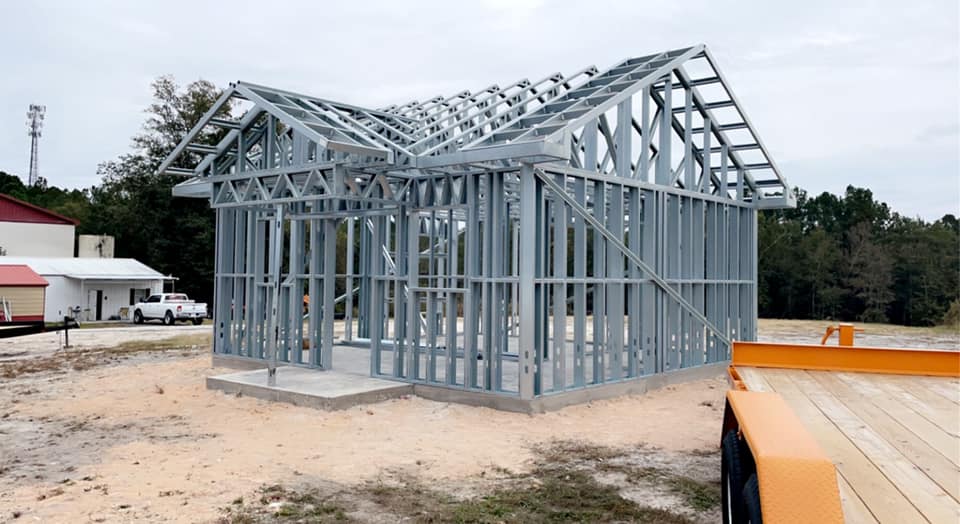
Fraaime's offsite precision framing system produces a 5,000 sq ft structure with waste that fits in a single dustbin. Not a reduced-waste build. Not a low-waste build. A build where material is calculated so precisely, and cut so accurately, that the concept of a "waste factor" doesn't apply.
That single dustbin replaces the four to five full dumpsters that the same project would generate under conventional field framing. The lumber that would have filled those dumpsters doesn't get purchased, doesn't get cut incorrectly, and doesn't need to be hauled away. The savings show up in the material budget, in the disposal budget, and in the labor hours that would have been spent managing waste on a cluttered site.
The framing phase is where the financial character of a project is often set. Get it right, and every trade that follows works cleanly and on schedule. Get it wrong, and the cost of correction accumulates invisibly — in adjustment cuts, in rework, in trade delays, in contingency drawdowns. Precision framing isn't just a better way to build. It's a better financial decision, made at the moment that matters most.
Key Takeaways
The waste buffer problem | Standard practice builds an 8–12% waste factor into every lumber order — meaning projects intentionally over-purchase material they expect to discard. |
Downstream rework | Out-of-square framing causes cascading problems for every finishing trade that follows — cabinetry, flooring, tile, and drywall all absorb the cost of framing imprecision. |
The takeoff is the root cause | Manual material calculations rely on rules-of-thumb that break down on complex geometry. AI-generated takeoffs are exact — no buffers, no guesses. |
One dustbin vs. five dumpsters | Fraaime's precision framing reduces a 5,000 sq ft build to a single dustbin of waste — compared to four to five full dumpsters under conventional framing. |
The financial case | Precision estimating can reduce total project overruns by up to 18% — on a $500k build, that's potentially $90,000 saved without changing the design. |
Ready to frame smarter?
The real expense of stick framing isn't the lumber — it's everything that surrounds it. A close look at where budgets actually bleed on a conventionally framed build, and what changes when every cut is calculated before the first board is lifted.
Lumber waste factor | Estimating savings | Typical residential waste |
|---|---|---|
10–15%of all lumber purchased on a conventionally framed home becomes cut waste — before it ever becomes part of the structure. | 18%is the potential cost reduction when framing is built from precise calculations rather than rule-of-thumb waste buffers. (Industry data) | 3–5 lbsof construction debris per square foot on a new build. A 5,000 sq ft home generates thousands of pounds of waste — most of it structural lumber. |
Walk any conventional job site mid-frame and you'll find the same scene: offcuts stacked in the corner, a dumpster half-full by Tuesday, and three framers measuring the same wall from different points. Nobody is doing anything wrong. It's simply how residential construction has worked for decades — and the inefficiency has been absorbed into standard practice so thoroughly that most builders no longer see it as a problem at all.
But it is a problem. And the numbers make that uncomfortable to ignore.
The Material That Never Becomes a Building
According to the National Association of Home Builders, excess or unused wood accounts for up to 40% of all jobsite waste on a residential build. Most estimators account for this by baking an 8–12% waste buffer into every lumber package — a figure so normalized that it appears in standard takeoff software as a default. On a $40,000 framing material package, that's $3,200 to $4,800 in lumber that was ordered knowing it would be discarded.
This is before the disposal costs. A typical new construction build generates 3–5 pounds of debris per square foot. A 5,000 sq ft home produces somewhere between 7.5 and 12.5 tons of waste. At current landfill tipping rates and dumpster rental fees, the cost of simply removing the waste a project creates is meaningful — often running to several thousand dollars that never appears in the framing bid but lands in the project budget regardless.
Too many builders and contractors accept waste as an unavoidable consequence of construction, without enough consideration being given to how waste adds to a project's cost."
The issue isn't incompetence. Conventional stick framing involves a large number of field decisions made under time pressure: measuring, marking, cutting, installing, adjusting. Each step introduces a probability of error. A stud cut a quarter-inch short becomes waste. A header ordered to the wrong length is a phone call, a delay, and a premium delivery charge. A wall that goes up slightly out of plumb means adjustment cuts downstream — more waste, more time.
The Downstream Cascade Nobody Budgets For
What makes framing waste particularly expensive isn't just the material itself — it's what happens after. Out-of-square walls ripple through every finishing trade that follows. A cabinetry contractor working to millimeter tolerances will spend hours shimming and adjusting when the walls they're working against have accumulated half-inch variances. Flooring installers face the same issue. Tile work that should be square rarely is, and the fix is always someone's time — time that comes at a premium hourly rate.
The NAHB's data shows that a typical new single-family home uses roughly 15,000 board feet of framing lumber. Getting that framing right the first time — and not having to correct for variances later — isn't just about material efficiency. It's about protecting the schedule and the margins of every trade that follows.
Industry research shows that professional, precision-based estimation can reduce material costs alone by 10–15%, and that overall project overruns can be cut by up to 18% when framing is built from exact calculations rather than rule-of-thumb buffers. On a $500,000 build, that's a potential $90,000 improvement — without changing a single architectural decision.
The Takeoff Problem
At the heart of framing waste is the takeoff: the process of calculating how much material a project requires. Traditionally, this is a manual exercise — a framer or estimator works through a set of plans, counting wall lengths, door and window openings, beam spans, and floor areas, then applies standard rules-of-thumb to produce a material list.
The problem is that rules of thumb are calibrated for simple, standard structures. The moment a plan includes bump-outs, cathedral ceilings, multi-level framing, or non-rectangular geometry, those shortcuts break down. The estimator has to make judgment calls. Some of those calls result in over-ordering (material sitting on site, getting weathered, and eventually discarded). Others result in under-ordering (crew waiting, emergency delivery at premium pricing, schedule slipping).
AI-generated framing packages eliminate this problem structurally. The system reads the geometry of an architectural plan with precision — not approximating, not rounding to the nearest standard dimension, but calculating the exact length of every stud, the precise span of every header, the optimal layout of every panel relative to the structural load path. The resulting material takeoff is exact. There is no buffer, because there are no guesses.
What Zero Waste Actually Looks Like
Fraaime's offsite precision framing system produces a 5,000 sq ft structure with waste that fits in a single dustbin. Not a reduced-waste build. Not a low-waste build. A build where material is calculated so precisely, and cut so accurately, that the concept of a "waste factor" doesn't apply.
That single dustbin replaces the four to five full dumpsters that the same project would generate under conventional field framing. The lumber that would have filled those dumpsters doesn't get purchased, doesn't get cut incorrectly, and doesn't need to be hauled away. The savings show up in the material budget, in the disposal budget, and in the labor hours that would have been spent managing waste on a cluttered site.
The framing phase is where the financial character of a project is often set. Get it right, and every trade that follows works cleanly and on schedule. Get it wrong, and the cost of correction accumulates invisibly — in adjustment cuts, in rework, in trade delays, in contingency drawdowns. Precision framing isn't just a better way to build. It's a better financial decision, made at the moment that matters most.
Key Takeaways
The waste buffer problem | Standard practice builds an 8–12% waste factor into every lumber order — meaning projects intentionally over-purchase material they expect to discard. |
Downstream rework | Out-of-square framing causes cascading problems for every finishing trade that follows — cabinetry, flooring, tile, and drywall all absorb the cost of framing imprecision. |
The takeoff is the root cause | Manual material calculations rely on rules-of-thumb that break down on complex geometry. AI-generated takeoffs are exact — no buffers, no guesses. |
One dustbin vs. five dumpsters | Fraaime's precision framing reduces a 5,000 sq ft build to a single dustbin of waste — compared to four to five full dumpsters under conventional framing. |
The financial case | Precision estimating can reduce total project overruns by up to 18% — on a $500k build, that's potentially $90,000 saved without changing the design. |
Ready to frame smarter?
The real expense of stick framing isn't the lumber — it's everything that surrounds it. A close look at where budgets actually bleed on a conventionally framed build, and what changes when every cut is calculated before the first board is lifted.
Lumber waste factor | Estimating savings | Typical residential waste |
|---|---|---|
10–15%of all lumber purchased on a conventionally framed home becomes cut waste — before it ever becomes part of the structure. | 18%is the potential cost reduction when framing is built from precise calculations rather than rule-of-thumb waste buffers. (Industry data) | 3–5 lbsof construction debris per square foot on a new build. A 5,000 sq ft home generates thousands of pounds of waste — most of it structural lumber. |
Walk any conventional job site mid-frame and you'll find the same scene: offcuts stacked in the corner, a dumpster half-full by Tuesday, and three framers measuring the same wall from different points. Nobody is doing anything wrong. It's simply how residential construction has worked for decades — and the inefficiency has been absorbed into standard practice so thoroughly that most builders no longer see it as a problem at all.
But it is a problem. And the numbers make that uncomfortable to ignore.
The Material That Never Becomes a Building
According to the National Association of Home Builders, excess or unused wood accounts for up to 40% of all jobsite waste on a residential build. Most estimators account for this by baking an 8–12% waste buffer into every lumber package — a figure so normalized that it appears in standard takeoff software as a default. On a $40,000 framing material package, that's $3,200 to $4,800 in lumber that was ordered knowing it would be discarded.
This is before the disposal costs. A typical new construction build generates 3–5 pounds of debris per square foot. A 5,000 sq ft home produces somewhere between 7.5 and 12.5 tons of waste. At current landfill tipping rates and dumpster rental fees, the cost of simply removing the waste a project creates is meaningful — often running to several thousand dollars that never appears in the framing bid but lands in the project budget regardless.
Too many builders and contractors accept waste as an unavoidable consequence of construction, without enough consideration being given to how waste adds to a project's cost."
The issue isn't incompetence. Conventional stick framing involves a large number of field decisions made under time pressure: measuring, marking, cutting, installing, adjusting. Each step introduces a probability of error. A stud cut a quarter-inch short becomes waste. A header ordered to the wrong length is a phone call, a delay, and a premium delivery charge. A wall that goes up slightly out of plumb means adjustment cuts downstream — more waste, more time.
The Downstream Cascade Nobody Budgets For
What makes framing waste particularly expensive isn't just the material itself — it's what happens after. Out-of-square walls ripple through every finishing trade that follows. A cabinetry contractor working to millimeter tolerances will spend hours shimming and adjusting when the walls they're working against have accumulated half-inch variances. Flooring installers face the same issue. Tile work that should be square rarely is, and the fix is always someone's time — time that comes at a premium hourly rate.
The NAHB's data shows that a typical new single-family home uses roughly 15,000 board feet of framing lumber. Getting that framing right the first time — and not having to correct for variances later — isn't just about material efficiency. It's about protecting the schedule and the margins of every trade that follows.
Industry research shows that professional, precision-based estimation can reduce material costs alone by 10–15%, and that overall project overruns can be cut by up to 18% when framing is built from exact calculations rather than rule-of-thumb buffers. On a $500,000 build, that's a potential $90,000 improvement — without changing a single architectural decision.
The Takeoff Problem
At the heart of framing waste is the takeoff: the process of calculating how much material a project requires. Traditionally, this is a manual exercise — a framer or estimator works through a set of plans, counting wall lengths, door and window openings, beam spans, and floor areas, then applies standard rules-of-thumb to produce a material list.
The problem is that rules of thumb are calibrated for simple, standard structures. The moment a plan includes bump-outs, cathedral ceilings, multi-level framing, or non-rectangular geometry, those shortcuts break down. The estimator has to make judgment calls. Some of those calls result in over-ordering (material sitting on site, getting weathered, and eventually discarded). Others result in under-ordering (crew waiting, emergency delivery at premium pricing, schedule slipping).
AI-generated framing packages eliminate this problem structurally. The system reads the geometry of an architectural plan with precision — not approximating, not rounding to the nearest standard dimension, but calculating the exact length of every stud, the precise span of every header, the optimal layout of every panel relative to the structural load path. The resulting material takeoff is exact. There is no buffer, because there are no guesses.
What Zero Waste Actually Looks Like
Fraaime's offsite precision framing system produces a 5,000 sq ft structure with waste that fits in a single dustbin. Not a reduced-waste build. Not a low-waste build. A build where material is calculated so precisely, and cut so accurately, that the concept of a "waste factor" doesn't apply.
That single dustbin replaces the four to five full dumpsters that the same project would generate under conventional field framing. The lumber that would have filled those dumpsters doesn't get purchased, doesn't get cut incorrectly, and doesn't need to be hauled away. The savings show up in the material budget, in the disposal budget, and in the labor hours that would have been spent managing waste on a cluttered site.
The framing phase is where the financial character of a project is often set. Get it right, and every trade that follows works cleanly and on schedule. Get it wrong, and the cost of correction accumulates invisibly — in adjustment cuts, in rework, in trade delays, in contingency drawdowns. Precision framing isn't just a better way to build. It's a better financial decision, made at the moment that matters most.
Key Takeaways
The waste buffer problem | Standard practice builds an 8–12% waste factor into every lumber order — meaning projects intentionally over-purchase material they expect to discard. |
Downstream rework | Out-of-square framing causes cascading problems for every finishing trade that follows — cabinetry, flooring, tile, and drywall all absorb the cost of framing imprecision. |
The takeoff is the root cause | Manual material calculations rely on rules-of-thumb that break down on complex geometry. AI-generated takeoffs are exact — no buffers, no guesses. |
One dustbin vs. five dumpsters | Fraaime's precision framing reduces a 5,000 sq ft build to a single dustbin of waste — compared to four to five full dumpsters under conventional framing. |
The financial case | Precision estimating can reduce total project overruns by up to 18% — on a $500k build, that's potentially $90,000 saved without changing the design. |
Ready to frame smarter?
Table of contents
Written by

Lorenzo B.
Engineering Lead
Category
Cost & Waste
Speed